Dc Circuit Diagram

Dc circuit diagram
A direct current circuit is an electrical circuit that consists of any combination of constant voltage sources, constant current sources, and resistors. In this case, the circuit voltages and currents are independent of time.
How do DC circuits work?
Direct current is fairly straightforward. DC power strictly flows in one direction. That means the electrons get pushed in from the power generator, and keep going forward through the wire until it gets to your device, does its work, then continues through the outlet to complete its circuit.
What is DC circuits examples?
The most basic example of a DC circuit is a flashlight where we only connect a battery, a switch, and a light bulb or LED.
What is the formula of DC circuit?
| Equation | Symbols |
|---|---|
| P = I Δ V P = I \Delta V P=IΔV | P P P is power, I is current, and Δ V \Delta V ΔV is electric potential difference |
What voltage is DC?
There are a variety of DC voltage levels, typical values are 1.2, 1.5, 3, 3.3, 3.6, 5, 6, 10, 12, 15, 18, 18.5, 19, 20, 24, and 48 Volts. An ideal DC supply should provide a constant voltage and adequate current throughout the operation of the equipment.
Where is DC used?
Direct current is used in any electronic device with a battery for a power source. It is also used to charge batteries, so rechargeable devices like laptops and cell phones come with an AC adapter that converts alternating current to direct current.
Is DC current negative or positive?
DC is short hand for Direct Current, meaning that the polarity of the voltage remains constant (positive or negative). In a DC circuit, it is generally accepted that current flows from positive to negative. A common source of DC is a battery.
Why are DC circuits important?
A DC circuit is necessary for DC electricity to exist. DC circuits may be in series, parallel or a combination. Understanding DC circuits is important for learning about the more complex AC circuits, like those used in the home.
Why is DC current used?
DC power is significantly more energy efficient than AC power. DC motors and appliances have higher efficiency and power to size characteristics. DC-based lighting (LED) is as much as 75% more efficient than incandescent lighting.
Can DC run in parallel?
When two or more electrical components are connected in a way that one end of each component is connected to a common point and the other end is connected to another common point, then the electrical components are said to be connected in parallel, and such an electrical DC circuit is referred as a parallel DC circuit.
What is the difference between AC and DC circuit?
Electric current flows in two ways as an alternating current (AC) or direct current (DC). The main difference between AC and DC lies in the direction in which the electrons flow. In DC, the electrons flow steadily in a single direction, while electrons keep switching directions, going forward and then backwards in AC.
Why DC is not used in homes?
Direct current can not be easily stepped up or stepped down with the help of transformers whereas alternating current can easily be converted from low voltage to high voltage or vice-versa with the help of transformers. The possibility of electrolytic corrosion is more in DC than in AC.
What is DC source?
A dc voltage source consisting of two or more cells that converts chemical, nuclear, solar, or thermal energy into electrical energy.
How do you test a DC circuit?
How to measure dc voltage with a digital multimeter
- Then insert the red probes into the V Ω jack. When finished, remove the probes in reverse order: red first, then black.
- Connect the test probes to the circuit: black to the negative polarity test point (circuit ground), red to positive test point.
How do you find the voltage in a DC circuit?
Through Ohm's law, you can calculate the voltage (V), current (I) and resistance (R) of a DC circuit. From that you can also calculate the power at any point in the circuit. Follow Ohm's law: Voltage (V) = Current (I) times Resistance (R).
Why is AC used over DC?
The Difference Between AC & DC The main factor that went into the choice of AC over DC was that AC is more efficient. Its ability to travel back and forth made gave it the ability to travel over longer distances. Thus making it able to power more homes.
How do you convert AC to DC?
The most common way to convert alternating current into direct current is to use one or more diodes, those handy electronic components that allow current to pass in one direction but not the other. Although a rectifier converts alternating current to direct current, the resulting direct current isn't a steady voltage.
What devices use DC current?
Most household appliances and consumer electronics—cellphones, laptops, microwaves, light bulbs, you name it—use direct current (DC) electricity.
What are the 3 types of DC sources?
DC Circuit Types Every electrical circuit can be classified into three groups – series, series-parallel and parallel. Thus, DC circuits can be divided into three categories: series DC circuit, series and parallel DC circuit, and parallel DC circuit.
What is DC energy?
In direct current (DC), the electric charge (current) only flows in one direction. Electric charge in alternating current (AC), on the other hand, changes direction periodically.
13 Dc circuit diagram Images
How to Make a 12V DC to 220V AC Inverter
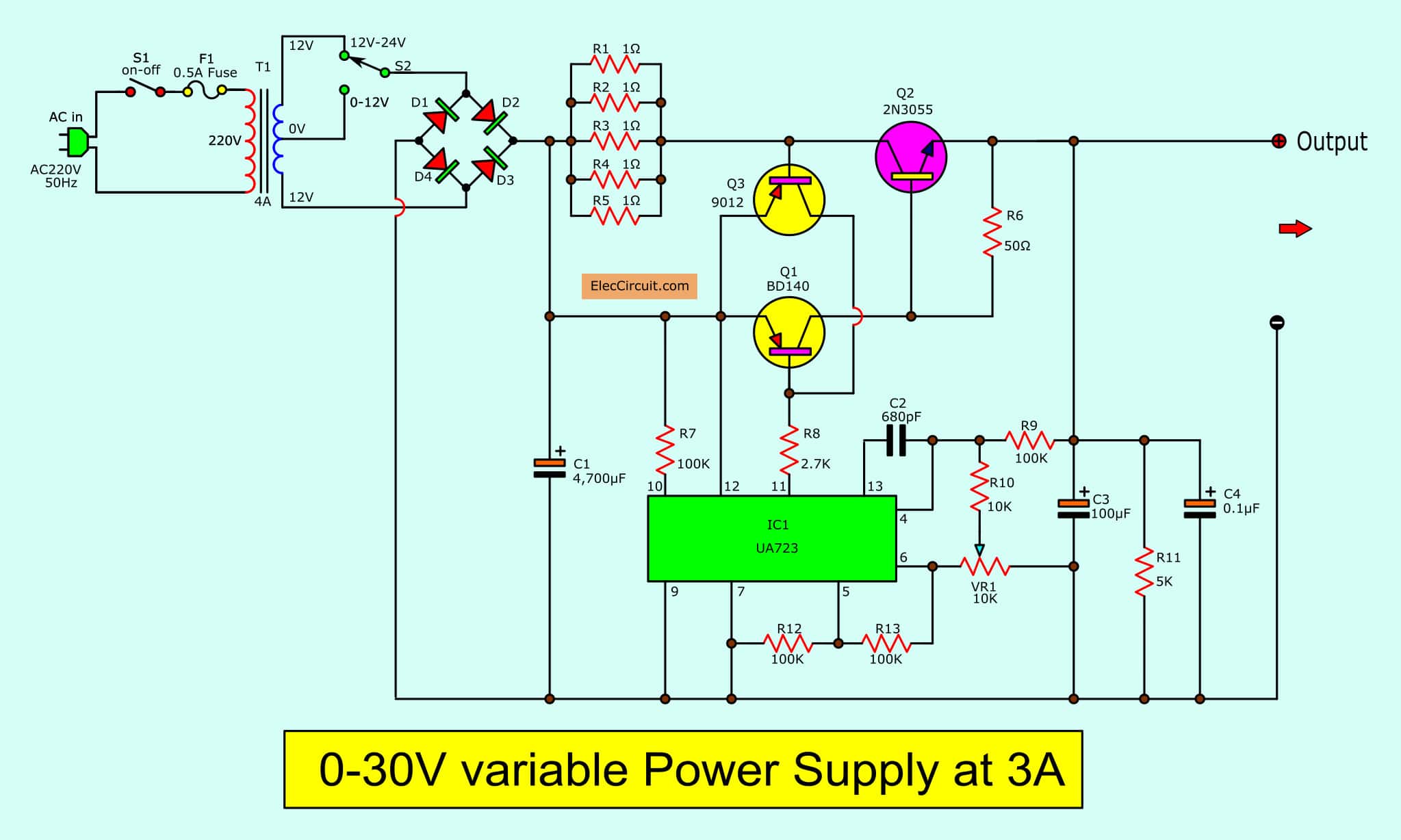
Variables Circuit diagram Power supply

ac 220v to dc 9v transformerless power supply Hobby Electronics

12V DC to 220V AC Converter Tested Circuit Circuit design

220230v ac to 12v5v DC Regulated Power DC converter Bridge Rectifier

Dc voltage doubler Circuit Electronic circuit design Electrical

DC to DC Boost Converter Circuit Homemade Electronics Project

Variable Output Voltage DC to DC Boost Converter using MC34063

Dc motor speed controller circuit using NE555 Diagrama de circuito

Circuit Diagram Dc Circuit Arduino Fm Band Function Generator

Pin on dc circuits basic

555 PWM LED dimmer circuit diagram Power Battery Saving Circuit

Post a Comment for "Dc Circuit Diagram"